Table of Contents
Introduction: Why 2026 Is the Defining Year for AI Engineers Worldwide
Artificial Intelligence is no longer a niche technology — it is the backbone of modern business operations across every continent. From healthcare diagnostics in Boston to financial fraud detection in London, and from autonomous vehicle systems in Germany to enterprise automation in Singapore, AI systems are transforming industries at an unprecedented pace.
According to the World Economic Forum’s Future of Jobs Report 2026, AI and related technologies will create approximately 170 million new roles globally by 2030, while displacing roughly 92 million existing ones — resulting in a net positive of 78 million jobs. However, the workers losing roles are not automatically the ones filling the new ones. The gap between displacement and creation is a reskilling gap, and closing it is now the most urgent operational challenge facing organizations worldwide.
The financial rewards reflect this urgency. Workers with demonstrable AI skills earn on average 56% more than peers in comparable roles without those skills — a premium that has more than doubled in just one year, according to cross-referenced WEF and LinkedIn Economic Graph research.
LinkedIn’s 2026 Jobs on the Rise report identifies AI Engineer as the #1 fastest-growing job title for the second consecutive year. Between 2023 and 2025, LinkedIn added 639,000 AI-related job postings in the U.S. alone, including 75,000 for AI Engineer roles. Employers across technology, financial services, defense, consulting, and academia are hiring entry-level AI talent at record rates.
But here’s the challenge: the role of an AI Engineer has evolved dramatically. Companies no longer want candidates who merely understand machine learning theory. They need professionals who can design, build, optimize, and deploy intelligent systems at scale — from Retrieval-Augmented Generation (RAG) pipelines to autonomous AI agents.
This blog is your definitive global roadmap. Whether you are a student in Europe, a fresher in Asia, or a working professional in North America looking to upskill, this guide will walk you through every step of becoming a job-ready AI Engineer in 2026.
What Does an AI Engineer Actually Do in 2026?
An AI Engineer builds software systems that use machine learning models and large language models (LLMs) to perform tasks like prediction, pattern recognition, language understanding, and autonomous decision-making. In 2026, the role sits at the intersection of software engineering, machine learning, and system deployment.
Unlike Data Scientists who focus on building predictive models from data, or Prompt Engineers who optimize text inputs for LLMs, AI Engineers are responsible for the entire lifecycle of AI systems:
- Designing data pipelines and preprocessing workflows
- Integrating pre-trained LLMs into production applications
- Building RAG systems that ground AI responses in real company data
- Deploying AI agents that autonomously execute multi-step workflows
- Monitoring, evaluating, and maintaining AI systems at scale
As Gartner highlights in its 2026 predictions, 75% of recruitment processes will incorporate AI certifications and proficiency tests by 2027, making practical, demonstrable skills more critical than ever.
The Global AI Market: Why Demand Is Exploding
Understanding the scale of the opportunity requires looking at the global numbers:
Table
| Metric | Figure | Source |
|---|---|---|
| Global AI market size (2026) | $539.45 billion | Grand View Research |
| Global AI market projected (2033) | $3,497.26 billion | Grand View Research |
| Global Generative AI market (2026) | $83.3 – $161 billion | GM Insights / Fortune Business Insights |
| Global GenAI CAGR (2026–2035) | 31.6% – 33.2% | Coherent Market Insights / GM Insights |
| Global AI spending (2026) | $301 billion | Mordor Intelligence |
| Worldwide software market revenue | $743 billion | U.S. Bureau of Labor Statistics / Boundev |
| New U.S. software jobs by 2033 | 327,900 | U.S. Bureau of Labor Statistics |
| AI-related job postings growth (2023–2025) | 639,000 in the U.S. | |
| AI talent demand vs. supply ratio | 3.2:1 globally | UVIK Global Talent Index |
| Workers needing reskilling by 2030 | 59% of global workforce | World Economic Forum |
The global generative AI market alone is valued between $83.3 billion and $161 billion in 2026, with projections reaching $900 billion to $1.26 trillion by the mid-2030s. North America holds the largest share at approximately 45–48%, while Asia-Pacific is the fastest-growing region, driven by massive government investments in China, India, Japan, and South Korea.
92% of Fortune 500 companies have already adopted generative AI technology, including major brands like Coca-Cola, Walmart, Apple, General Electric, and Amazon.
AI Engineer Salary Guide 2026: Global Compensation Breakdown
AI Engineer salaries vary significantly by region, experience, and specialization. Here is the comprehensive global breakdown based on 2026 data from Glassdoor, Levels.fyi, Built In, and KORE1 placement research.
United States
Table
| Experience Level | Years | Base Salary Range | Total Comp (Est.) |
|---|---|---|---|
| Entry Level | 0–2 | $90,000 – $135,000 | $110,000 – $160,000 |
| Mid-Level | 3–5 | $140,000 – $210,000 | $170,000 – $260,000 |
| Senior | 6–9 | $180,000 – $280,000 | $220,000 – $350,000+ |
| Staff / Principal | 10+ | $250,000 – $400,000+ | $350,000 – $600,000+ |
Key U.S. Markets:
- San Francisco / Bay Area: $210K–$250K base | $270K–$390K+ total comp
- New York City: $195K–$225K base | $240K–$340K+ total comp
- Seattle: $185K–$220K base | $230K–$330K+ total comp
- Austin: $155K–$195K base | $190K–$260K+ total comp (best value market)
- Remote (U.S.): $155K–$210K base | $195K–$280K+ total comp
Glassdoor reports the average AI engineer salary in San Francisco at $212,859, with the 75th percentile reaching $272,195. Built In reports an even higher average base of $246,250.
PwC’s 2025 AI Jobs Barometer found a 56% wage premium for roles requiring AI skills versus the same roles without — up from just 25% the previous year.
Europe
Table
| Country | Junior | Mid | Senior | Staff/Principal |
|---|---|---|---|---|
| UK (London) | £55K–£80K | £80K–£115K | £110K–£170K | £160K–£250K |
| Germany (Berlin/Munich) | €55K–€75K | €75K–€105K | €100K–€155K | €140K–€220K |
| France (Paris) | €50K–€70K | €70K–€95K | €90K–€135K | €130K–€200K |
| Netherlands (Amsterdam) | €60K–€80K | €80K–€110K | €105K–€150K | €140K–€210K |
European AI engineer pay rose meaningfully in 2024–2025 but still lags U.S. numbers by roughly 35–55% at senior levels. However, compensating factors include lower taxes in some jurisdictions (e.g., Dutch 30% ruling for expats), significantly lower cost of living outside London/Paris/Amsterdam, and exceptional benefits like 30+ vacation days and strong job protections.
Berlin-specific data: Median AI engineer salary is €86K, with Wayfair leading at €146K average total comp, followed by Wolt (€120K) and Amazon (€115K). Google Berlin pays €120K–€145K for senior engineers.
Asia-Pacific & Other Regions
Table
| Region | Senior Level Range | Notes |
|---|---|---|
| India | ₹40L–₹95L (~$48K–$115K USD) | Fastest-growing AI talent pool; 5.2M new GitHub developers in 2025 |
| China | ¥600K–¥1.5M+ RMB | Strong domestic AI ecosystem; government-backed initiatives |
| Japan | ¥12M–¥20M JPY | Electronics manufacturing & automotive AI focus |
| Singapore | S$120K–S$220K | Regional AI hub; strong fintech demand |
| LATAM | $50K–$110K USD | Growing remote hiring market |
| Africa | $35K–$90K USD | Emerging market; strong remote potential |
Skills That Boost Your Salary Globally:
- LLMs & Large Language Models — 40–60% premium over generalist roles
- RAG (Retrieval-Augmented Generation) — Most deployable enterprise skill
- LangChain / LangGraph — Industry-standard agent frameworks
- Vector Databases — Pinecone, ChromaDB, Weaviate
- MLOps / LLMOps — 25–40% premium for production deployment skills
- Prompt Engineering — Foundation skill for all LLM work
The 2026 AI Engineer Skill Stack: What Hiring Teams Actually Want
Before diving into the roadmap, let’s understand the core skills that define a modern AI Engineer. Based on 2026 global hiring data and industry reports, here is the real checklist that separates candidates who get interviews from those who don’t.
1. Strong Programming Fundamentals (Python is Non-Negotiable)
Python remains the undisputed language of AI engineering. Despite TypeScript overtaking Python as the most-used language by monthly GitHub contributors in August 2025, Python contributors still grew 48% year-on-year to 2.6 million, and Python usage rose +7 percentage points in the Stack Overflow Developer Survey 2025 — the largest single-year jump for any major language in over a decade.
Six of the ten fastest-growing open-source repositories on GitHub in 2025 were AI infrastructure projects, and the Python-heavy ones (vLLM, sglang, RAGFlow) led that list.
Hiring teams expect:
- Clean, efficient code with proper error handling
- Experience with REST APIs, JSON parsing, and async programming
- Version control with Git and GitHub portfolio management
- Basic SQL for data interaction
2. LLM Application Development
This is where 2026 differs from previous years. AI Engineers must know how to:
- Call LLM APIs (OpenAI GPT-4o, Anthropic Claude, Google Gemini, Mistral)
- Design prompts with structured outputs (JSON schemas via Pydantic)
- Implement function calling and tool use
- Handle failure cases like ambiguous inputs, refusals, and retries
3. RAG (Retrieval-Augmented Generation) — The Most Employable Skill
RAG is the single most deployed LLM architecture in enterprise today. It connects LLMs to company documents and databases, ensuring responses are grounded in actual data rather than hallucinated training knowledge. Key RAG skills include:
- Document chunking and embedding strategies
- Vector databases (Pinecone, ChromaDB, pgvector, Weaviate)
- Retrieval logic, reranking, and hybrid search
- Frameworks like LangChain and LlamaIndex
- Evaluation with RAGAS for automated quality scoring
4. AI Agents and Agentic Workflows
2026 is the year agentic AI moves from demos to enterprise workflows. AI Engineers must understand:
- The ReAct (Reason + Act) loop
- Multi-agent orchestration with LangGraph and CrewAI
- Tool calling and persistent memory
- State management and conditional routing
5. MLOps / LLMOps and Production Deployment
Building a model is only 20% of the job. The remaining 80% is making it work reliably in production:
- Containerization with Docker
- API deployment with FastAPI
- Cloud platforms: AWS, Google Cloud, Azure
- Monitoring and tracing with LangSmith
- Evaluation frameworks like RAGAS for automated quality scoring
6. MCP (Model Context Protocol)
MCP is Anthropic’s open standard for connecting AI models to external tools, databases, and services. In 2026, it is becoming the enterprise standard for AI interoperability. Engineers who can build MCP servers are in a small minority of the AI workforce.
7. Mathematics and Statistics (Intuition, Not Memorization)
You don’t need to be a mathematician, but understanding these concepts is crucial:
- Linear Algebra: How models represent data as vectors and matrices
- Probability & Statistics: Measuring uncertainty and evaluating predictions
- Optimization: How gradient descent improves model accuracy during training
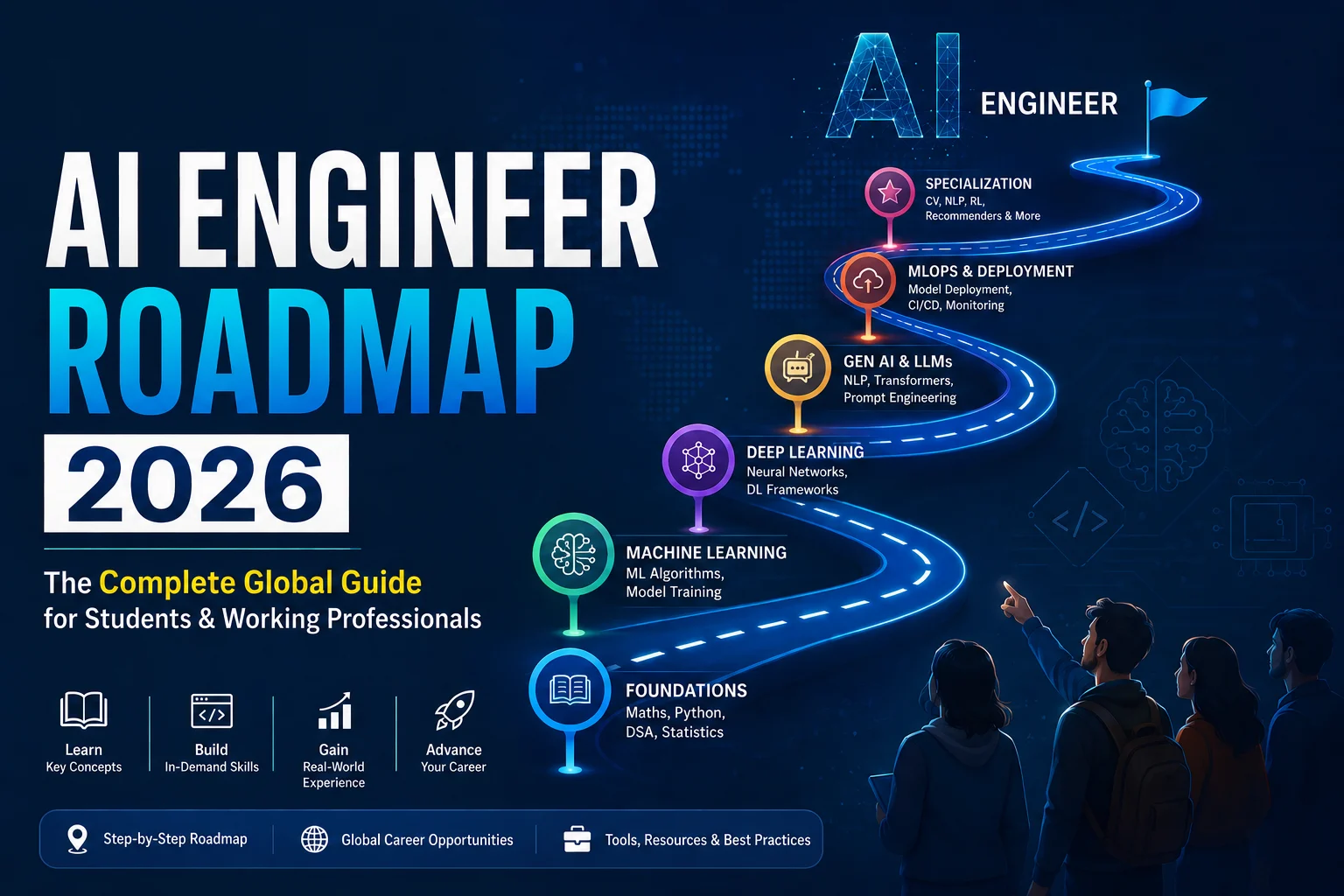
The Complete AI Engineer Roadmap: 7 Stages (3–6 Months)
This roadmap is designed for learners studying 8–12 hours per week. It takes you from zero AI experience to building and deploying production-grade AI systems.
Stage 1: Python, APIs & Software Basics (Weeks 1–2)
Goal: Build the non-negotiable foundation.
- Python intermediate: functions, classes, dictionaries, list comprehensions, JSON handling
- REST APIs: making HTTP requests with
requestsorhttpx, handling authentication and rate limiting - Environment variables: storing API keys safely with
.envfiles - Git & GitHub: version control, branching, README files
- Basic SQL: SELECT, INSERT, JOIN operations
Pro Tip: You do NOT need NumPy, pandas, or traditional machine learning experience to start AI engineering in 2026. If you can build a simple REST API that calls an external API, you are ready for Stage 2.
Stage 2: LLMs and Prompt Engineering (Weeks 3–4)
Goal: Learn to interact with large language models programmatically.
- LLM API calls: OpenAI (GPT-4o), Anthropic (Claude), Google (Gemini), Mistral
- Understanding chat messages, roles (system/user/assistant), and completions
- Prompt engineering: system prompts, few-shot examples, chain-of-thought reasoning
- Structured outputs: getting LLMs to return JSON using Pydantic models
- Token management: context windows, token counting, cost control
- Function calling: defining tools that LLMs can invoke
First Project: Build a simple chatbot that calls an LLM API and maintains conversation context.
Stage 3: RAG and Vector Databases (Weeks 5–9)
Goal: Master the most employable AI engineering skill.
- Retrieval-Augmented Generation: Connecting LLMs to your documents at query time
- Document loading & chunking: PDFs, Word docs, web pages — split into semantically coherent chunks
- Embeddings: converting text to vectors using models like
text-embedding-3-smallor BGE - Vector databases: ChromaDB (local), Pinecone (cloud), pgvector (PostgreSQL extension), Weaviate
- LangChain & LlamaIndex: Orchestrating the full RAG pipeline
- RAGAS evaluation: measuring faithfulness, relevancy, and context recall
Key Insight: Chunking strategy is the most impactful factor in RAG quality. Most beginners focus on the model; professionals focus on how data is prepared and retrieved.
Project: Build a full RAG pipeline — PDF → chunk → embed → store → retrieve → generate. Deploy it with FastAPI.
Stage 4: AI Agents and Agentic Workflows (Weeks 10–13)
Goal: Build systems that plan, act, and execute autonomously.
- ReAct Loop: Reason about what to do → call a tool → observe → decide next step
- Tool calling in depth: defining reliable tools with clear descriptions
- LangGraph: Production-grade agent framework with stateful graph execution
- CrewAI: Role-based multi-agent collaboration
- Agent memory: conversation memory, entity memory, external stores
Important: Learn RAG before agents. Agents use RAG for knowledge retrieval, and LangChain patterns from Stage 3 transfer directly to LangGraph.
Project: Build a multi-agent research assistant using LangGraph that can search, summarize, and cite sources.
Stage 5: MCP and External Tool Integration (Weeks 14–15)
Goal: Connect AI systems to enterprise infrastructure.
- Model Context Protocol (MCP): Anthropic’s open standard for AI interoperability
- Building MCP servers that expose internal APIs, databases, and services
- Enterprise integrations: CRMs (Salesforce), project tools (Jira), email, internal knowledge bases
- Authentication & security: OAuth 2.0, API key management, scope controls
Career Advantage: MCP is becoming the enterprise standard for AI interoperability. Engineers who can build MCP servers are in a small minority of the AI workforce as of 2026.
Stage 6: Deployment, Monitoring & LLMOps (Weeks 16–18)
Goal: Take AI systems from local development to production.
- FastAPI: Building async AI APIs with automatic OpenAPI documentation
- Docker: Containerizing AI services for consistent deployment
- Cloud deployment: AWS Lambda, GCP Cloud Run, Azure Container Apps
- LangSmith: Tracing every LLM call, retrieval step, and agent action
- Evaluation & RAGAS: Automated regression testing for AI quality
- Cost optimization: prompt caching, model tier selection, rate limiting
Stage 7: Portfolio Projects & Career Preparation (Weeks 19–22)
Goal: Build a hiring-ready portfolio.
7 Must-Have Projects:
- RAG Knowledge Assistant — Document Q&A with citations
- AI Resume Screener — Automated candidate evaluation
- Multi-Agent Researcher — LangGraph-based research workflow
- MCP Productivity Assistant — Connected to your tools
- Customer Support Chatbot — With guardrails and safety checks
- AI Workflow Automation — End-to-end business process
- Deployed AI API — With LangSmith monitoring and cost controls
Golden Rule: One well-built, deployed RAG project is worth more than ten half-finished notebooks. Hiring managers evaluate projects, not certificates.
Top AI Certifications to Validate Your Skills (2026)
While projects matter most, certifications from authoritative providers add credibility. Here are the most recognized credentials globally:
Table
| Certification | Provider | Level | Cost | Best For |
|---|---|---|---|---|
| Google Professional Machine Learning Engineer | Google Cloud | Professional | $200 | Google Cloud ML deployment |
| Google AI Professional Certificate | Foundational | Free–Paid | General workplace AI literacy | |
| AWS Certified Generative AI Developer – Professional | Amazon | Professional | $300 | AWS Bedrock & production GenAI |
| AWS Certified Machine Learning Engineer – Associate | Amazon | Associate | $150 | AWS-based ML engineering |
| Microsoft AI-901 (Azure AI Fundamentals) | Microsoft | Foundational | ~$99 | Azure beginners (AI-900 retired June 2026) |
| Azure AI Engineer Associate (AI-102) | Microsoft | Associate | Variable | Azure OpenAI solutions |
| LangChain Academy | LangChain | Skill-based | Free/Paid | Agent builders |
| Anthropic Academy | Anthropic | Skill-based | Free | Claude and Claude Code users |
Strategy: One broad credential + one stack-specific credential is enough. After that, projects matter significantly more. According to McKinsey predictions, 50% of AI roles will require certifications by 2026.
Important Notes:
- AWS Certified Machine Learning – Specialty retired March 31, 2026. Existing holders keep the credential for 3 years.
- Microsoft AI-900 retired June 30, 2026. AI-901 is the replacement path.
- DeepLearning.AI short courses are useful for learning but do not offer official certificates.
The Biggest Trends Shaping AI Engineering in 2026
To future-proof your career, understand where the industry is heading globally:
1. Agentic AI Moves From Demos to Enterprise Workflows
Unlike chat-based tools that generate responses, agentic AI systems plan tasks, use tools, call APIs, and execute multi-step workflows autonomously. Gartner predicts that by 2029, AI agents will generate 10 times more data from physical environments than all digital use cases combined.
2. Multimodal AI Becomes Standard
Text-only AI is becoming obsolete. In 2026, models process and generate combinations of text, images, audio, and video within unified systems. This expands use cases across healthcare, manufacturing, and customer service.
3. Model Optimization & Smaller Models
Organizations now recognize that not every task needs a frontier-level model. Model routing architectures dynamically assign tasks to the most appropriate model — complex reasoning to large models, routine tasks to smaller, optimized ones. This reduces costs while maintaining performance.
4. Trust, Safety & Governance
As AI systems become embedded in critical workflows, trust and safety are no longer optional. The EU AI Act is influencing global standards, requiring transparency and fairness in AI systems. Enterprises require human-in-the-loop review, auditability, and adversarial resilience. Gartner warns that 50% of AI agent deployment failures will stem from inadequate governance.
5. Global Talent Redistribution
Remote work has normalized permanent geographic flexibility. Companies hire from India, Brazil, Eastern Europe, and Africa at scale, with offshoring saving up to 60% versus U.S. domestic rates. India is projected to surpass the U.S. as the #1 developer population by 2028.
Common Mistakes to Avoid on Your AI Journey
❌ Focusing Only on Tools
Learning LangChain or PyTorch without understanding fundamentals limits your growth. Tools change; principles don’t.
❌ Ignoring Software Engineering Basics
Clean code, API design, testing, and version control are assumed knowledge. Weakness here undermines your entire profile.
❌ Skipping Real Projects
Theory without practice is worthless. Build, break, and deploy. Your GitHub is your real resume.
❌ Neglecting Evaluation
Many engineers build RAG systems but cannot explain why retrieval quality is poor or how to measure improvement. Learn RAGAS and evaluation frameworks early.
❌ Chasing Every New Model
New models release weekly. Focus on architectural patterns (RAG, agents, MCP) rather than memorizing every model’s specs.
How to Start Your AI Engineering Journey Today
For Students & Freshers:
- Start with Python — Build a strong programming foundation
- Complete Stage 1–3 — Focus on one excellent RAG project
- Deploy publicly — Use FastAPI + Docker + free cloud tiers
- Build a GitHub portfolio — Clear READMEs, architecture diagrams, live demos
For Working Professionals (Software Developers):
- Leverage your existing skills — You can skip basic Python/API stages
- Focus on LLM integration — Stage 2–4 can be completed in 2–4 months
- Add AI to your current projects — Propose an internal RAG tool or automation agent
- Transition gradually — Many companies prefer internal mobility for AI roles
For Data Scientists & Data Engineers:
- Data Scientists: Your ML foundations and evaluation thinking are direct advantages. Focus on LangChain, RAG quality metrics, and FastAPI deployment.
- Data Engineers: Your pipeline thinking makes you naturally strong at RAG system design. Focus on embedding pipelines, vector database ingestion, and production monitoring.
30–60–90 Day Action Plan
For developers studying 8–12 hours per week alongside work:
Table
| Phase | Days | Focus Areas |
|---|---|---|
| First 30 Days | 1–30 | Python intermediate, LLM APIs, prompt engineering, structured outputs, first chatbot project |
| Days 31–60 | 31–60 | LangChain RAG pipelines, embeddings, ChromaDB, full RAG project, FastAPI deployment |
| Days 61–90 | 61–90 | LangGraph agents, tool calling, CrewAI, MCP basics, Docker, LangSmith tracing, portfolio project |
Conclusion: The Time to Act Is Now
The AI Engineer role in 2026 is not about knowing the most tools or memorizing the latest model architectures. It is about building complete, reliable, production-grade AI systems — from RAG pipelines that ground responses in real data to agentic workflows that autonomously execute business processes.
With the global AI market projected to reach $3.5 trillion by 2033, 170 million new AI-related roles created by 2030, and AI Engineer identified as the #1 fastest-growing job on LinkedIn for two consecutive years, the opportunity has never been greater.
But opportunity favors the prepared. The engineers who will lead in 2026 are those who:
- Master the fundamentals (Python, APIs, software engineering)
- Build real projects (RAG systems, AI agents, deployed APIs)
- Understand evaluation and production deployment (LLMOps, monitoring, cost control)
- Stay curious and continuously adapt (AI evolves weekly, not yearly)
Your roadmap is clear. Your timeline is 3–6 months. Your future as an AI Engineer starts today.
Frequently Asked Questions (FAQ)
What is the salary of an AI Engineer in 2026?
In the U.S., entry-level AI Engineers earn $90K–$135K base ($110K–$160K total comp). Senior roles reach $180K–$280K base ($220K–$350K+ total). In Europe, senior roles range from €90K–€155K depending on the city. Workers with AI skills earn a 56% wage premium over peers without.
How long does it take to become an AI Engineer?
With structured learning (8–12 hours/week), 3–6 months is realistic for developers and technical professionals. Freshers may need 6–12 months depending on their programming background.
Is Python enough for AI Engineering?
Python is essential but not sufficient. You also need skills in LLM APIs, RAG systems, vector databases, agent frameworks, and cloud deployment.
What is the difference between an AI Engineer and a Data Scientist?
Data Scientists build predictive models from data using statistics and ML theory. AI Engineers build production applications using pre-trained LLMs, RAG, and agents — focusing on deployment, integration, and scalability.
Do I need a CS degree to become an AI Engineer?
No. While a technical background helps, skills and a project portfolio matter most. Many successful AI Engineers are self-taught or come from non-CS backgrounds.
What are the best projects for an AI Engineer portfolio?
Top projects include: RAG knowledge assistant with citations, multi-agent research system, AI resume screener, MCP-connected productivity tool, and a deployed API with LangSmith monitoring.
What is the AI talent shortage situation globally?
AI talent demand exceeds supply 3.2:1 globally in 2026, with approximately 1.6 million open positions worldwide against approximately 518,000 qualified candidates. The World Economic Forum reports 94% of leaders face AI-critical skill shortages.
Which region pays AI Engineers the most?
The San Francisco Bay Area remains the highest-paying market globally, with senior AI Engineers earning $270K–$390K+ in total compensation. However, remote roles at U.S.-paying companies offer competitive packages with significantly lower cost of living.
Ready to start your AI Engineering journey? Explore ITCareersHub.in for more career guides, certification resources, and job opportunities in the global tech landscape.
This blog is for informational purposes. Salary figures and market data are based on publicly available 2026 reports from Glassdoor, Levels.fyi, Built In, the U.S. Bureau of Labor Statistics, the World Economic Forum, LinkedIn, and Grand View Research. Figures may vary by company, location, and individual skills.


 admin
admin